Section outline
-
Core24 : Introduction to the Production Arts

This course is intended for students who seek alternatives to a four-year college. This course will have a focus on audio but will cover the core concepts of performance production techniques. The course is designed to start students with the rudiments of terminology, introduce them to the concepts and, devices used in theater and concerts and take them through the fundamentals of audio, lighting, and A/V technologies. This online course will be an excellent primer for students who wish to attend the Production Institute in Athens GA or any other school for vocational training in audio engineering.If prospective students can complete this course as high school seniors they will be well prepared to tackle the fast-paced environment of hands-on classes and in real-world situations. Don't spend tens of thousands of dollars on a course without the fundamental knowledge you'll need to stay at the top of your class. The production arts are a group of highly specialized skill sets and they all start with the fundamentals of the science of sound and lighting, and the conventional wisdom of the industry.
-
Week 1 : Introduction to Production Arts
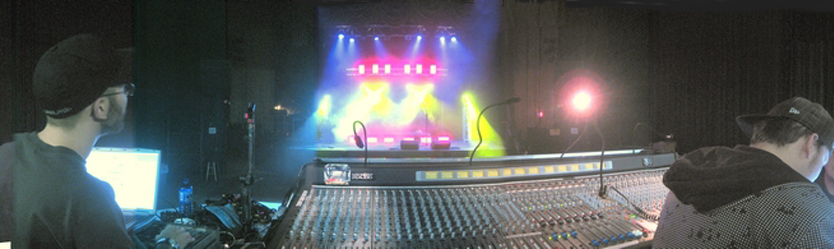
In this first course, we will take a look at all the crafts and talents that make up the Production Arts Industry. It takes a lot of talented people to create a professional production of anything. Everything from Broadway to university commencement ceremonies to rock concerts requires a host of talented people working in unison to produce a successful program.
-
Week 2: Production Arts Terminology & Vocabulary

In this course, we will study professional AV terminology. If you can't understand what artists and other engineers and designers are talking about,
how can you do the job? That's just it, it's just about impossible to do without some formal introduction.The lexicon of the AV industry is unique and in many cases, overlaps one craft and another. This means that AV pros must understand not only their primary craft but that of the other crafts they are working with. Stages and theaters are inherently dangerous places. A lack of understanding of what's being communicated can put you or possibly others in grave danger. A clear understanding of terminology is the primary pillar of the creed, Safety First!
-
Week 3 : Drawings, Diagrams and Documentation

Documentation of small or large-scale AV systems is a requirement before an installation occurs. Even if it is a temporary installation. Planning
ahead for signal path and power distribution alone can require detailed drawings, line diagrams, and schematics. This course will examine
common forms of documentation and learn how to both read & create documentation for other AV professionals. Communication skills are one
of the three pillars of professionalism. The ability to document an AV system or what you specifically need an AV system to do for you is one part of those communication skills that you need to develop. Communication, cooperation, and Collaboration are the three pillars of Professionalism. -
Week 4 : Audio Devices & Concepts

In this course, we will focus on audio devices and the concepts behind them. Most devices have specific jobs to perform but some are universal by the nature of their application. Equalizers have many applications but noise gates have far fewer useful places in the signal path. Many of these dynamic processors can be patched together in unique and interesting ways but that sort of approach may not lead to better sound results. More is not always better in the audio field! We will look closely at individual devices and their use in specific professional situations as well as some rules of thumb to remember when patching these devices together.
-
Week 5: The of Science Sound

Sound and its propagation have always been a topic of scientific research. Consider that the Romans built amphitheaters that held upwards of one hundred thousand people and they are known to have employed methods of geometry for instance to improve the intelligibility of someone speaking from the stage. Throughout time man has been trying to extend the range of the human voice or music to a larger audience. Consider the megaphone.
By coupling the acoustic impedance of your vocal chords to a larger mass of air the acoustic energy is increased in a specific direction. During this week's class, we will examine the physical constants of sound, some of the science behind sound propagation, and modern advances in sound reinforcement. Consider, via the internet your voice can be heard around the world instantaneously. As little as 50 years ago, not even satellite technology could connect the entire globe without great expense and resources! Now all you need is a webcam.
-
Week 6: The Science of Light

Lighting is a beautiful and wonderful thing to witness when it's done well. Lighting a stage for a film, a play, or a live performance all rely on a common group of theories. Color mixing in light and color mixing in pigment take two very different approaches to their application. All color mixing is actually performed by your brain via electrical stimulation of cells in the retina of the eye. Understanding the basics of these processes and the science behind color mixing is where lighting designers begin their careers. Nonetheless, everyone involved in planning and deploying a production should understand the basics of light theory and how to communicate with their professional counterparts. This class will examine color theory and color mixing and the functions of the different methods of mixing color in light and pigment.
-
Week 7 : Intro to A/V System Elements
Audiovisual systems are simply a way of saying sound reinforcement, videotaping, and playback, lighting design, and control all in one word. An AV system is a group of hardware and operators that work together to create a cohesive performance. In this course, we will examine the various elements of these systems and how they are connected together and operated simultaneously.
-
Week 8: Cable for AV & Stage

Visual identification of cabling in an AV environment is at the heart of becoming an engineer. One must be able to distinguish the cable type, its use, the type of signal that it is carrying, and where and what it should be connected to. Failure to recognize visually what's happening with the signal path is a common error. One must learn the techniques of documenting signal path via documents and diagrams but a good engineer can also "see" the entire signal path of all of his signals in his or her head. Visualization of your signal path is crucial for safety reasons, planning for the unexpected, planning for the expected, planning for problems with fallback schemes and redundancy, and most importantly, troubleshooting problems. When you run into problems you have to be able to visualize where the problem could originate from!
-
Week 9: Connectors for AV & Stage

Visually identifying connectors and their associated connection points are paramount to the engineer that must "patch" or "pin" the stage. It's not unusual for bands to have as many as 48 inputs. It's even more common to have several bands sharing the bill that all require very large numbers of channel inputs and carry all their own mics and DI's etc. Generally, this is accommodated by planning ahead via documentation of your signal path and using the artist's stage plots, using your resources in smart ways, and having plenty of XLR cables.
In this course, we will examine the wide range of connectors used in professional AV, the signals they are designed to carry, and the workflow methods you will need to use when you have multiple bands on a stage. What's known as "the patch" has gotten more than a few engineers in big trouble when they didn't write it all down! It can be complicated and messy and if you don't get it right the first time the performance can be ruined to some degree!
-
Week 10: Signal Path

Signal path is the term used to denote how you get certain types of audio signals from point A to point B and then back again. You might be required to account for litereally hundreds of different wires that are all carrying signals of differnt types, strengths, and useability and could quite possibly be quite dangerous. Only by planning ahead can you ensure that you are prepared to get a signal where you need it.
Digrams and documentation and the first and foremost part of planning but the visualization techniques discussed in chapter 9 are good to employ when one is planning an event. Audio engineers are often called on to provide audio signal feeds from mixing consoles to support everything from TV programs to speeches. Understanding the characteristics of the cables and the connectors and the signal you are using is important for normal operation.
-
Week 11: Mixing Console Overview
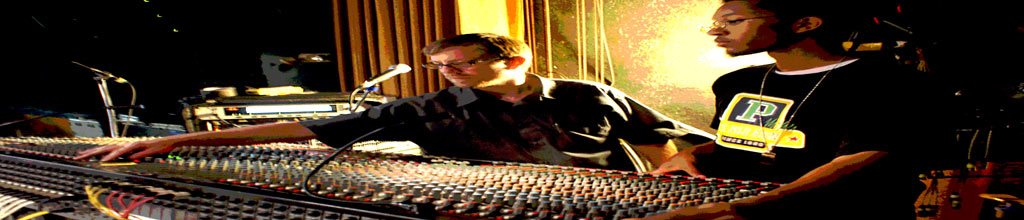
With the advent of digital mixing consoles, what seemed like easy operations on a simple analog console can become daunting to perform on a digital mixer. But in reality, they both use the same audio toolbox. In fact, a digital mixer often gives the live sound engineer the same dynamic tools that a studio engineer or a mastering engineer would use to enrich the quality of the sounds in a recording studio environment.
Despite using the same audio toolbox, the two different typs of mixers, analog & digital, have inherently different appraoches to signal path and gain stucture. In this course, we will examine the fundamental physical differences between the two without delving into subjective or collective value or their quality of sound.
-
Week 12: Gain Structure
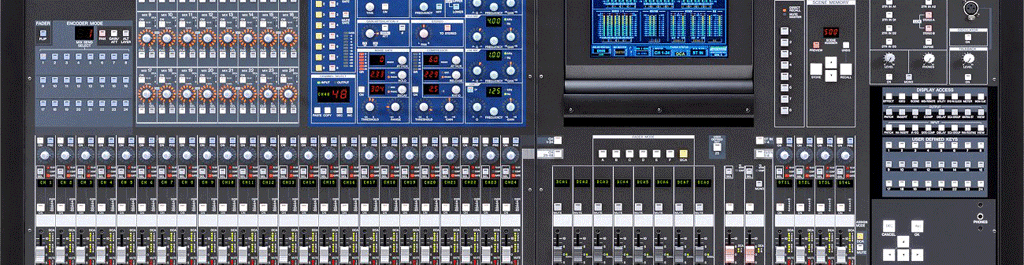
Gain structure is defined as a balanced of signals throughout the signal chain. The signal chain starts at the input stage of an audio mixing console. It could be a microphone or it could be an iPod that is connected. One type of signal requires high amounts of gain added to it whereas the latter requires relatively little added gain
in comparison to the microphone. There are many "gain stages" in a mixing console. Just as there is an input amplifier for the microphone, there is an output signal fed from the amplifier to the next gain stage. Balancing the inputs and outputs of all the gain stages in a console is achieved by using metering. The best consoles allow you to meter levels at any spot in the signal chain. This is crucial to what I call Relative Audio Balancing. Voices and instruments vary wildly in timbre and pitch and making adjustments that make individual sounds relative to one another involves adjusting the gain at different points. Dynamic processing such as limiting or compression is designed to help the engineer keep levels within the acceptable design limits of the circuitry. Input clipping, over-saturation, phase cancellation, and other phenomena that are relative to audio signals "in the wire" are to be avoided at all costs. In this course, we will learn how to effectively manage gain structure.