Section outline
-
Live9 Online : Audio Basics 101
This is a course made up of nine classes. Each class page looks very similar to any other class besides the banners and the list of goals and sources materials. This is so the interface is simple and direct.
Your weekly goals are plainly stated at the beginning of each class. In addition, the links to internet resources are listed, and reading assignments from the two textbooks, the Sound Reinforcement Handbook & Theatrical Design and Production, are outlined.
Look for a news and topic forum on every class page. We will be using the forums a lot in these classes. If you are unfamiliar with forum-based websites, ask me for some help, and I'll explain it further. There will be other links below, such as the weekly chats. The weekly chat links take you to the internal chat client, which is limited to text only. We'll use an external group chat app to conduct live classes.
The left-side navigation is the easiest way to keep track of where you are, although you should check out your Dashboard too! Click on the link, and it will take you to the class page where you will find the materials and links for that class. Remember that you can access your classes from anywhere you have an internet connection, so users must learn to use their time wisely because there is a lot of reading to do! If you don't do the reading I assign in these classes, you will not pass the tests. You are on the honor system in the Moodle. I expect students to close their books when they take the quizzes. The good news is that there is "feedback" built into the quizzes, and you can take them as many times as you need to until you really understand the information.
Goals for every week:
- Complete all the reading assigned.
- Complete any writing assignments to create documents and upload them to the server.
- Take the quiz by Saturday.
- Log in to the Forums and post questions or answers and discuss documentation.
This course requires that you have a copy of the Sound Reinforcement Handbook and Theatrical Design & Production. If you have not obtained a copy of either book, tell your Learning Guide right away. You will not be able to pass this course without doing the reading, and there is a lot of it to do. Audio engineers and lighting designers need to be well versed in everything from power theory to theater design. Increasing your knowledge and vocabulary about the entertainment industry is the first step in becoming a professional.
-
Diagrams, Drawings & Documentation

Diagrams, drawings, and documentation are an essential part of planning and communicating with other audio engineers and audio vendors.Understanding and generating these documents is the first step in professionalism. After all, if you can't explain what's in your head with diagrams, lists, and maps, how well thought out can it be?
-
Signal Path

Signal Path must always be planned ahead of time.
Often the signal path is established well before any show ever takes place. And there's a good reason for that. Cabling is always limited and smart planning is required to ensure that you can transport signals to where you need them for the performance. Signal path is the term used to denote how you get certain types of A/V signals from point A to point B and then back again. You might be required to account for literally hundreds of different wires that are all carrying signals of a different type, strength, and usability and could quite possibly be quite dangerous.
Only by planning ahead can you ensure that you are prepared to get a signal where you need it. Diagrams and documentation are the first and foremost part of planning, but the creative visualization techniques discussed in Chapter 1 are good to employ when one is planning an event. Audio and video engineers are often called on to provide signal feeds from mixing consoles to support everything from TV feeds & multi-boxes to multi-track recording. Understanding the characteristics of the cables and the connectors and the signal you are using is important for normal operation and all of these mentioned have different characteristics.
-
Analog and Digital Console Overview
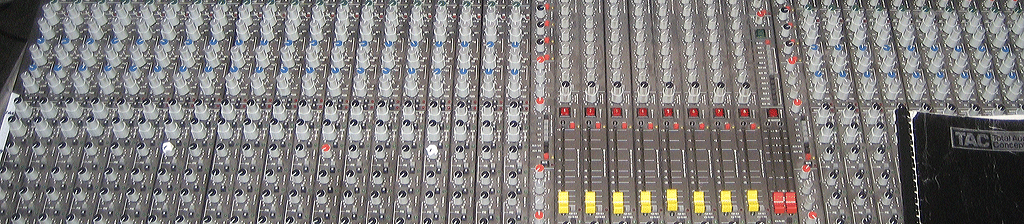
Despite the fact that Analog and Digital consoles use the same audio toolbox, there are serious differences that must be considered when using either type of mixer.Achieving the proper gain structure within either type of mixer is a good contrast in methods. With the advent of digital mixing consoles, what seemed like easy operations on a simple analog console can become daunting to perform on a digital mixer during a performance. But in reality, they both use the same audio toolbox. In fact, a digital mixer often gives the live sound engineer the same dynamic tools that a studio engineer or a mastering engineer would use to enrich the quality of the sounds as if you were in a recording studio environment. Despite using the same audio toolbox, the two different types of mixers, analog & digital, have inherently different approaches to signal path and gain structure. In this course, we will examine the fundamental physical differences between the two without delving into the subjective or collective value or their quality of sound. How to simplify seemingly complicated operations.
-
Gain Structure

Gain structure is the most misunderstood concept in the audio universe. Achieving high amounts of gain without over-saturation or clipping (distortion) is the goal, and it takes a "big picture" point of view to understand and adjust the gain structure of your console or PA system. You read that right. The console has a different gain structure than the PA, and getting the two to work in perfect harmony is the goal.This is an overview of the logic of Gain Structure to ensure proper throughput in any system. Gain structure is defined as a balance of signals throughout the signal chain of the entire sound system. The signal chain starts at the input stage of an audio mixing console. It could be a microphone, or it could be an iPod that is connected. One type of signal requires high amounts of gain added to it, whereas the latter requires relatively little added gain compared to the microphone.
There are many "gain stages" in a mixing console. Just as there is an input amplifier for the microphone, an output signal is fed from the amplifier to the next gain stage. Balancing the inputs and outputs of all the gain stages in a console is achieved by using metering. The best consoles allow you to meter levels at any spot in the signal chain. This is crucial to what I call Relative Audio Balancing. Voices and instruments vary wildly in timbre and pitch, and making adjustments that make individual sounds relative to one another involves adjusting the gain at different points. Dynamic processing such as limiting or compression is designed to help the engineer keep levels within the acceptable design limits of the circuitry. Input clipping, over-saturation, phase cancellation, and phenomena relative to audio signals "in the wire" are to be avoided at all costs. In this class, we will learn how to manage gain structure effectively.
-
Audio Dynamics
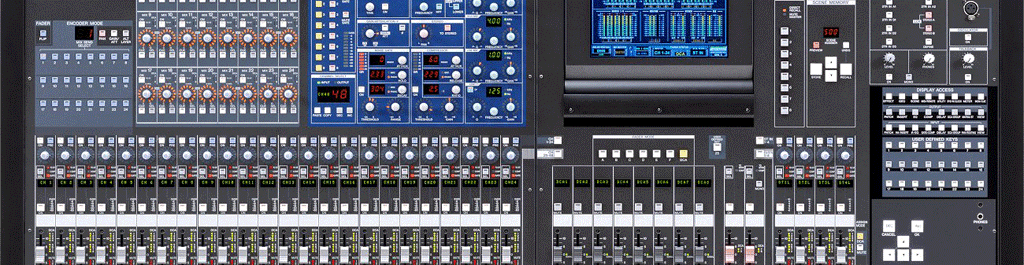
Audio dynamic processors are some of the hardest tools to use and implement correctly.Audio engineers must know how to control signals and dynamic range through the use of dynamic processing devices. Audio signals can often be affected by a wide range of both internal and external influences. For example, controlling excessive signal level or excessive dynamic range, stopping the bleed-through into mics from adjacent sound sources, and Brick-wall limiting functions are all achieved through the use of dynamic processing.
Unfortunately, these devices can ruin your sound just as easily as they can fix it! Understanding the operations of these devices, how and where they are connected to other devices, and the proper approach to setting the adjustments to dynamic processing are all topics we will cover in this week's class.
-
Live Audio Effects
Learning to use effects for live audio mixing will take your sound to a whole new space! Audio engineers must know how to operate Audio FX while mixing music. A live performance's "raw" sound can have a great deal more emotional impact when subtle effects like echo and reverb are added. Learning to use effects for live audio mixing will take your sound to a whole new space! A modern-day equivalent is known as Auto-Tune!
The psycho-acoustic phenomena associated with delays and echos have been used for many years by audio engineers to improve their mixes. However, reverberation, chorus effect, and other types of echos and signal delays can also play an important role in defining the emotional content of songs and performances. -
Advanced Mixing Techniques

Learning to control large numbers of inputs and all the other equipment at your fingertips is one of the biggest challenges of a professional audio engineer.Audio engineers have developed hardware within mixing systems to simplify this process and give themselves the tools they needed to stay on top of the fast-paced environment of a live performance. Learn the workflow of a pro in this class!
-
Feedback Elimination

Eliminate feedback before it can happen. Learn how professional audio engineers eliminate feedback from the audio system before any artist walks in the door.Identifying the room modes and free air resonance frequencies of a performance space and eliminating them before sound-check is the only way to assure that acoustic feedback cannot happen during a performance. There are straightforward methods that do not involve machinery or analysis by anything but your ears and brain. However, there are many useful devices for pinpointing troublesome frequencies, nodes and anti-nodes, and other wave phenomena that can severely affect your mix. We will examine both approaches in this class.
-
Power Distribution & Safety

Power distribution is paramount to the correct, noise-free operation of your equipment as well as the safety of you and your artists and your guests. Alternating Current is dangerous, and learning the safe and acceptable methods to distribute power is fundamental to any production. 99% of all buzzing, humming, 60 cycle noise is caused by improper grounding and multiple ground paths. Electricity always seeks the path of least resistance. Learn some fundamental aspects of AC-based power systems. This class has a focus on American power-grid standards. Many countries have varying systems and standards. In general, all the safety assumptions will work everywhere. As always, safety first!
